
The beginning of theatrical activity in Veliko Tarnovo can be traced back to 1869, when the “Nadezhda” community centre was established in the city. 14 March 1870 marks the date of the first theatrical performance in the city – the play was “The Much-Suffering Genoveva”. The event was attended by Vasil Levski, who, after watching the performance, established the Tarnovo Revolutionary Committee.
Over the following three years, theatrical activity developed rapidly. The repertoire was remarkable for its time – alongside Bulgarian National Revival plays, works such as “Emilia Galotti” by G. E. Lessing and “Hernani” by Victor Hugo were staged. Alarmed by the strong influence of the community centre, the Ottoman authorities prohibited its further activity and it was closed.
Theatrical activity resumed after the Liberation. On 10 February 1879, on the day the Constituent Assembly opened, the play “Ivanko, the Murderer of Asen” was performed in the building of the former Ottoman administrative residence. In August 1886, the first purpose-built theatre building in Bulgaria was opened here. Its façade bore the motto: “Unity Makes Strength”. The city was also home to the first theatrical tapestry curtain in Bulgaria, created by Otto Horeishi, a Czech artist devoted to the Tarnovo theatre.
In 1889, at the insistence of Prime Minister Stefan Stambolov, the first professional company was formed – the “Osnova” Theatre, directed by Anton Popov. Efforts to establish a permanent company in the city continued in the following years. In 1919, Konstantin Kisimov organized his first theatre company in Tarnovo, called the “Theatre Circle”. From 1928 to 1944, the “Nadezhda” community theatre operated in the city, employing professional actresses and actors, as well as several performers from Kisimov’s company. The theatre achieved remarkable success and established itself as a regional centre for cultural activity.
On 14 July 1952, the Regional People’s Theatre was established. It brought together the best performers from Tarnovo, Gorna Oryahovitsa, Tryavna, and the surrounding region. Additional actors were recruited through auditions from the theatres in Razgrad, Pleven, and Pazardzhik. The first director was Nikola Shivarov, and the first production was based on the play “Love” by Orlin Vasilev. In 1955, the theatre was declared a state institution. The first group of actors, together with a director and a dramaturge, arrived from VITIZ “Krastyo Sarafov”.
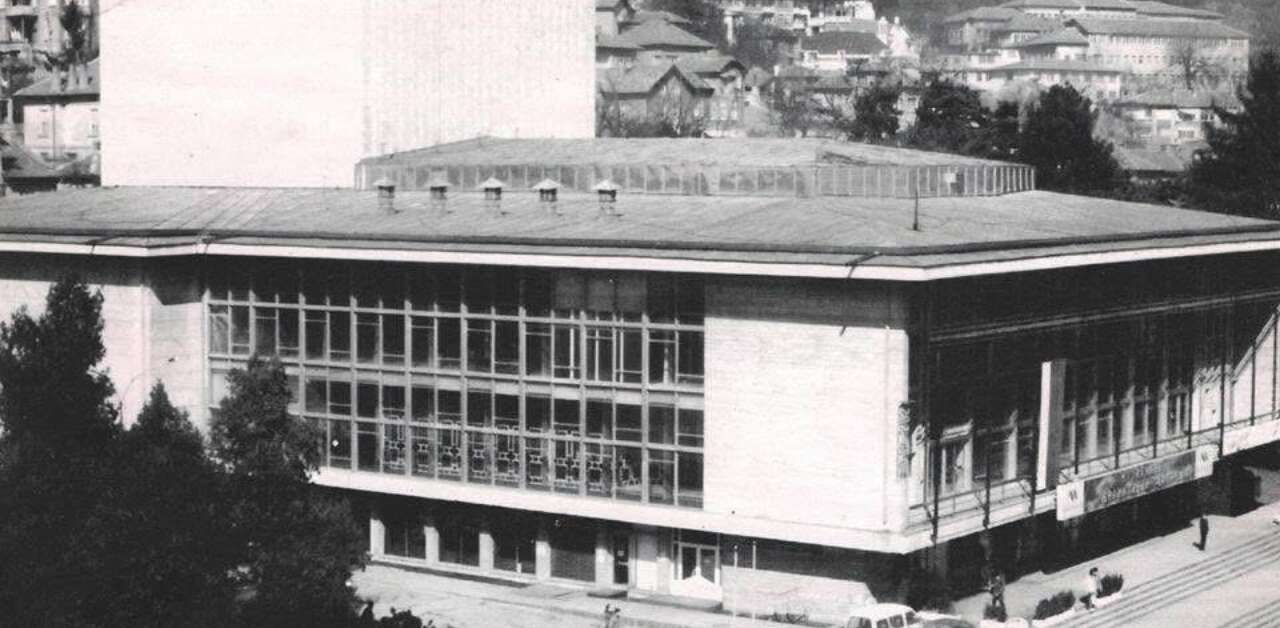
In 1959, an operetta branch was established. Director Nedyalko Kovachev and conductor Stayu Kasabov were appointed to lead it. The branch’s first premiere was the operetta “The Kiss of Chanita” by Y. Milyutin. In the same year, the idea of constructing a new theatre building emerged. Construction began in 1964. The theatre’s new home officially opened on 20 April 1971 with a production based on Ivan Vazov’s “Under the Yoke”.
In 1965, the theatre was named after its patron, Konstantin Kisimov. From 1972 onward, it officially became a Drama and Music Theatre. More than 50 creative seasons followed, during which each division maintained its own repertoire while joint productions were also staged regularly, including “The Kiss of Chanita”, “West Side Story”, “Don Quixote, the Man of La Mancha”, “Cabaret”, “Charley’s Aunt”, and many others.
The history of the Veliko Tarnovo theatre is associated with some of Bulgaria’s most distinguished performers, including Konstantin Kisimov, Dimitar Panov, Elena Stefanova, Milen Kolev, Lina Kovacheva, Nedyalko Kovachev, Stefan Samsiev, and many others.
Some of Bulgaria’s most prominent directors have also worked here, including Leon Daniel, Lyuben Groys, Mladen Kiselov, Yulia Ognyanova, Slavi Shkarov, Vili Tsankov, Krasimir Spasov, and many others.
Throughout its almost 160-year history, the theatre has presented nearly 15,000 performances.